

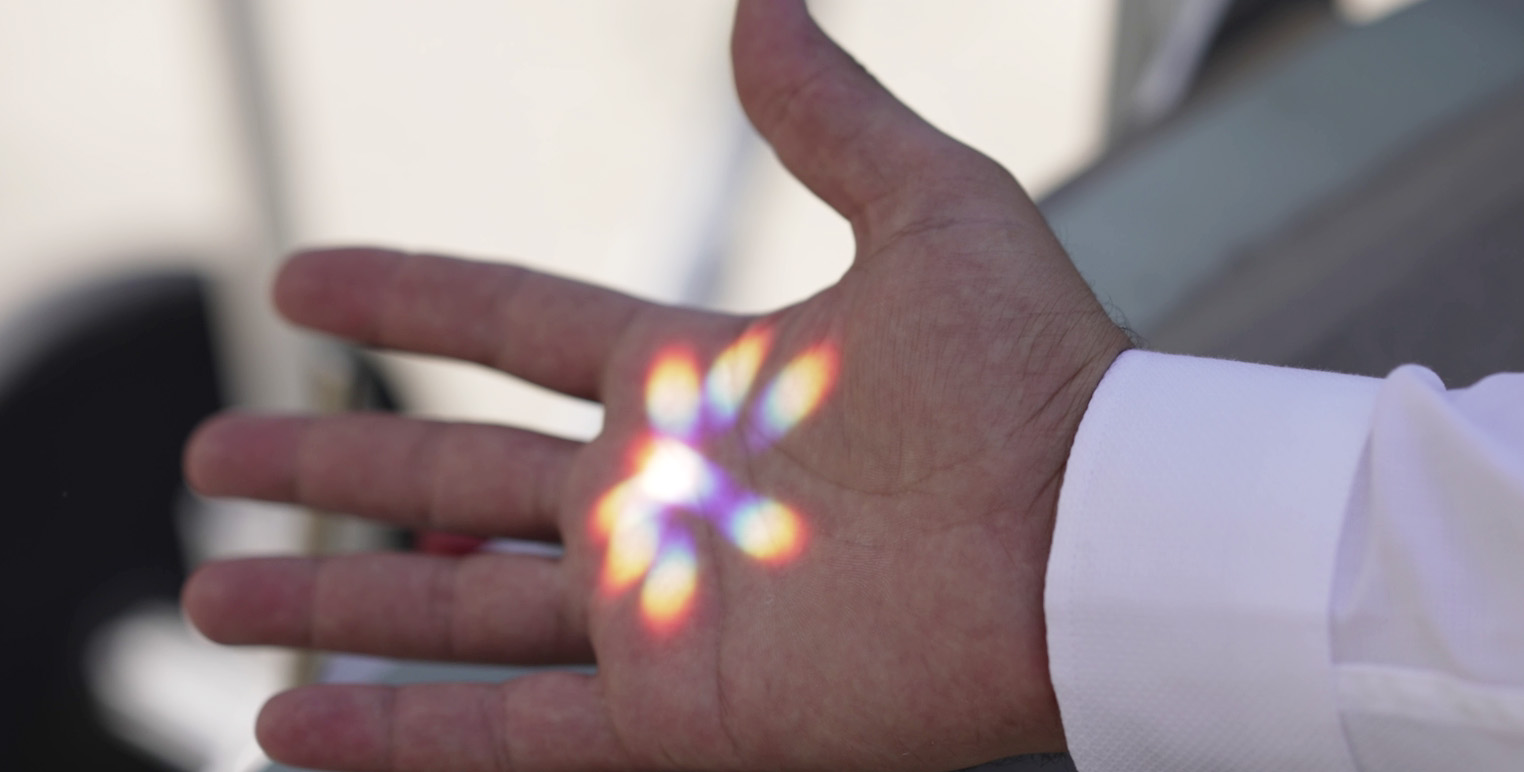
Thanks to a 100 square meter lens, the French startup concentrates sunlight to reach temperatures approaching 4,000°C, hot enough to melt virtually any material and transform it into a resource for the construction industry. The first plant is scheduled to open in 2026.
Heliosand plans to build two pilot units by 2026, capable of processing 5,000 tonnes of waste per year, with ambitions in energy and low carbon hydrogen.
By Pierre Fortin
Published June 14, 2025 at 9:30 AM
It is the story of two curious physicists, one a professor at Sorbonne University, the other an engineer at EDF, who heard about a strange experiment carried out on the edge of the Sahara Desert. Rafik Kheffache and Geoffrey Marino became fascinated by the invention of artist Markus Kayser, a 3D printer that concentrates sunlight to vitrify sand and create glass objects. “Even though we didn’t yet know where it would lead us, we felt this invention could have a wide range of applications,” recalls Rafik Kheffache.
After first considering melting Sahara sand into aggregates for construction sites in Dubai, they came up with the idea of using a giant lens to vitrify waste that is currently neither recycled nor reused, representing 34 percent of the 342.4 million tonnes of waste produced in France in 2018. But they faced a major technical challenge. “At the time, the largest lenses ever produced were only 10 square meters, whereas we needed a 100 square meter lens,” explains the physicist. “There was no industrial process capable of producing such a lens at a reasonable cost.” To overcome this challenge, Rafik Kheffache and Geoffrey Marino joined forces with Cécile Toussaint and Maxime Brun d’Arre to found Heliosand in Lyon in 2019.
Solar Furnace
Over several years, the team succeeded in developing a patented system capable of manufacturing a 100 square meter Fresnel lens while overcoming the precision issues associated with engraving the grooves inside the transparent surface. The process is inexpensive, and although its exact method remains a closely guarded secret within the Heliosand team, its effectiveness has been demonstrated on smaller prototypes.
The startup’s solar furnace can be compared to a telescope, with the giant lens forming one end and a 40 square centimeter surface mounted on a conveyor at the other, where the sun’s rays are concentrated. At that precise focal point, temperatures approach 4,000°C, making it possible to melt every known material in less than a second. Heliosand demonstrated this by liquefying tungsten, the material with the highest melting point on Earth at 3,422°C.
“We can potentially process every type of waste, even the most hazardous,” says Heliosand CEO Rafik Kheffache. “Laboratory tests have shown that at such temperatures, pollutants become chemically bound to the minerals and can no longer leach into soil or water.”
All kinds of waste can therefore be rendered inert, including asbestos, dredging sludge, bauxite residues, optical fiber waste, and fluorinated waste. After treatment, these wastes are transformed into two types of materials for the glass manufacturing and construction industries: either an obsidian like material that can be used to produce glass wool if the iron content is sufficiently low, or a sand or gravel substitute for construction projects. These innovative materials must still obtain certification from organizations such as Qualibat and the Scientific and Technical Center for Building.
Thanks to a patented process, Heliosand has developed a 100 square meter Fresnel lens capable of concentrating sunlight to treat the most hazardous waste.
100 Days of Sunshine to Break Even
A life cycle assessment conducted by Heliosand showed that its solar furnace avoids 1.5 tonnes of CO₂ emissions and permanently sequesters 0.5 tonnes of CO₂ for every tonne of waste treated, compared with the current waste management cycle.
As for pricing, the company has chosen not to disclose its rates but says its process is competitive with conventional hazardous waste treatment methods. “We pay neither for the incoming material nor for the energy, and we sell the output material,” the CEO points out. Furthermore, the natural intermittency of sunlight does not appear to be an obstacle to the process, which becomes economically viable with as few as 100 sunny days per year, a threshold that is easily exceeded in southern France.
Several industrial companies from different sectors have already signed contracts with Heliosand, including Yves Rocher, electronics manufacturer Cordon Group, and aluminum producer Trimet. “These companies have a genuine environmental commitment. Rather than burying waste that could not be treated, they chose to store it while waiting for a solution,” says Rafik Kheffache. The only downside is that none of these companies intends to install a solar furnace at its own facilities. Heliosand has therefore decided to build and operate its own treatment centers.
In addition to the €1.3 million it has raised since its creation from private investors, Bpifrance, and the Auvergne Rhône Alpes Region, the three employee company plans to raise another €2.6 million through a combination of debt financing, public funding, and crowdfunding to build its first two pilot units in early 2026, one in the Lyon area and the other near Marseille. “We have already secured €1.5 million from Bpifrance and our banking partners,” says the founder. “This will allow us to build two units capable of processing 5,000 tonnes of waste per year, with each site ultimately designed to accommodate four treatment units.”
In the future, however, Heliosand does not intend to limit itself to waste treatment. The company sees applications in industrial heat, electricity generation, and low carbon hydrogen production. It is enough to hope that this promising invention will prove closer to Archimedes’ mirrors than to Icarus’ dream.
