

By Pascal Poggi
November 25, 2025
Heliosand is developing a process that vitrifies hazardous waste, including asbestos containing materials, transforming it into harmless, inert rock that can be reused as a low carbon raw material for concrete production.
Founded in 2020 by three technology enthusiasts, Heliosand filed its first patent that same year and went on to build five prototypes to validate its process. By 2025, the company had grown into a multidisciplinary team of fifteen people based in Lyon, Grenoble, and Marseille, with support from major industrial partners including SIKA, EDF, Vinci, and Bouygues.
Heliosand has patented a technology capable of concentrating solar energy onto a surface area of 100 square meters, which is ten times larger than the previous world record for solar concentration. Its giant solar lenses convert sunlight directly into pure heat without requiring electricity or any additional energy source, while achieving maximum efficiency.
This proprietary solar concentration technology melts waste into lava at temperatures reaching 4000°C, neutralizing some of the most dangerous pollutants.
A Record Breaking Solar Concentration Technology
The Heliosand process produces a rock that can be used to manufacture environmentally friendly neo concrete. At 4000°C, pollutants are completely broken down, while the remaining material is transformed into valuable resources for the construction and public works industries.
The resulting material replaces the three main ingredients of conventional concrete, namely cement, clinker, and aggregates, with a material produced entirely from vitrified waste. This represents a powerful example of the circular economy in action.
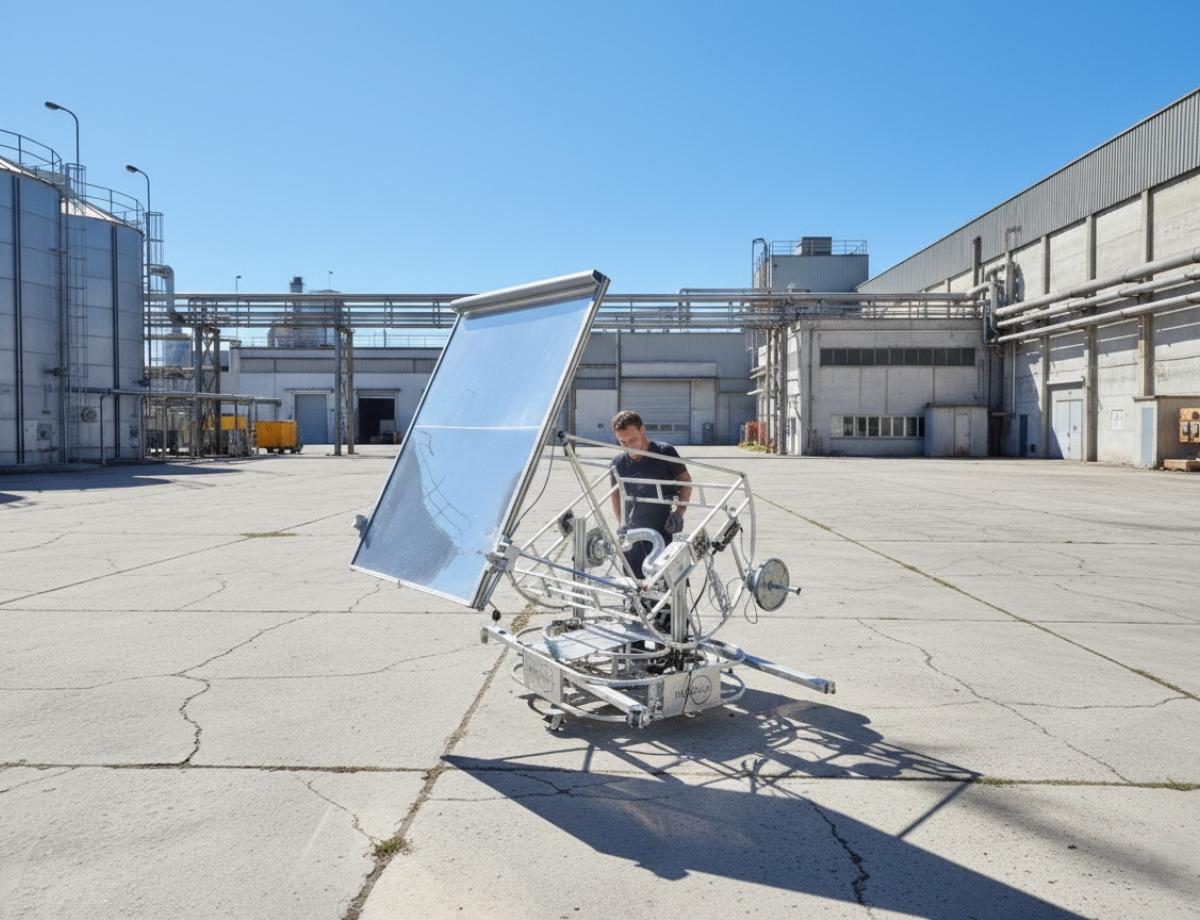
Heliosand’s solar lens is mounted on a proprietary solar tracking system designed to maximize efficiency throughout the day. The company is now operating its sixth prototype based on a Fresnel lens solar concentrator, capable of generating temperatures of up to 4000°C.
The technology can process four categories of waste:
- Asbestos
- Industrial sludge
- Ultimate waste
- Bauxite residues such as red mud
Without this process, these materials are generally either incinerated or sent to landfill.
More than twenty independent studies have analyzed the output materials, particularly those produced from asbestos waste, confirming the complete absence of asbestos fibers.
The vitrification process transforms asbestos fibers into a neutral, reusable material suitable for construction applications.
Public Fundraising Campaign
This is not the first time asbestos waste has been converted into an inert construction material. As early as 2016, the PROMES Laboratory, specializing in Processes, Materials and Solar Energy at the University of Perpignan, successfully transformed asbestos waste into refractory ceramics designed for thermal energy storage.
To accelerate its development, Heliosand plans to build its first industrial prototype capable of recycling 5000 tons of waste per year at a customer site during the second quarter of 2026. Looking further ahead, the company aims to deploy one hundred mobile recycling stations by 2035.
To finance this next stage, Heliosand has launched a public fundraising campaign. Opened on September 30, 2025, the campaign seeks to raise €500,000 by December 10 as part of a total investment requirement of €1.5 million.
The company’s founders are Geoffrey Marino, Chief Technology Officer, Cécile Tousssaint, Chief Operating Officer, and Rafik Kheffache, Chief Executive Officer. Also part of the leadership team is Maxime Brun d’Arre, Chief Financial Officer.
